Find, test and defend an edge.
Inference, time series, cross-validation, portfolio construction, model risk and research lineage.
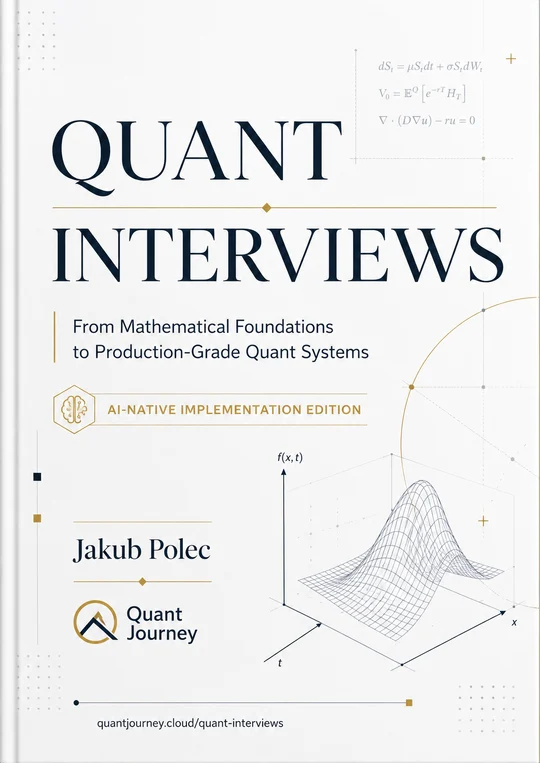
CH01 · CH02 · CH08 · CH09 · CH12 · CH14Quant Interviews is a two-volume guide for candidates who need to reason through mathematics, markets, research and the production systems behind real investment work. It contains 194 questions with derivations, implementation choices, failure modes and reproducible code.
 Volume I
I
Volume I
Volume II
Two volumes · Mathematics & Markets
Research & Systems
Many quant interview resources stop at a short answer or a puzzle. This book treats an interview question as evidence of how someone thinks: define the assumptions, derive the result, identify what breaks, implement it, test it and explain the production consequence. That makes it useful for interview preparation and as a reference once the interview is over.
Inference, time series, cross-validation, portfolio construction, model risk and research lineage.
CH01 · CH02 · CH08 · CH09 · CH12 · CH14Probability, derivatives, volatility, rates, market microstructure, execution and decision-making.
CH01 · CH05 · CH06 · CH07 · CH10 · CH13Numerical methods, data structures, C++, Python, SQL, reproducible backtests, APIs and deterministic replay.
CH02 · CH03 · CH10 · CH11 · CH12 · CH14Evidence quality, risk aggregation, capacity, attribution, stress testing, governance and production controls.
CH01 · CH07 · CH09 · CH10 · CH12 · CH14Each question is designed to make the reasoning inspectable. The companion repository contains public Python, C++20 and SQLite examples that mirror the chapter structure, so a reader can inspect a result rather than accepting it on authority.
The actual interview or desk scenario, stated precisely enough to expose hidden assumptions.
A clear route from assumptions to answer, including units, edge cases and conditions for validity.
Python, C++ or SQL where code makes the reasoning testable and operationally meaningful.
Leakage, instability, numerical error, market impact, stale data and the controls that make them visible.
These are not isolated keywords. The chapters build from probability and numerical reasoning into pricing, research, portfolio construction, execution and investment-system design. Each card below names representative questions drawn from the public implementation tree.
Find the topic you are preparing for
Base rates, dependence, Sharpe uncertainty, block bootstrap, false discoveries, optional stopping, Bayesian updates and expected utility.
Covariance matrices, factor models, Cholesky simulation, shrinkage, constrained Markowitz, risk parity and sparse portfolio design.
Root finding, implied volatility, quadrature, Monte Carlo, finite differences, automatic differentiation, calibration and adjoint sensitivities.
Filtrations, Ito integrals, Brownian motion, martingales, GBM, Ornstein-Uhlenbeck processes, Girsanov and Feynman-Kac.
State prices, put-call parity, option-surface arbitrage, binomial exercise, Black-Scholes, barrier options, local volatility and exotic bounds.
Greek sign checks, delta-hedged P&L, smile dynamics, skew, variance swaps, Heston, SABR and discrete hedging with jumps.
Curve bootstrapping, duration, DV01, multi-curve discounting, Hull-White, HJM, hazard rates, CDS and bond P&L explain.
Stationarity, ACF/PACF, cointegration, Kalman filters, regime switching, GARCH, purging, embargoes, calibration and live drift.
Mean-variance, Black-Litterman, risk parity, factor neutrality, transaction costs, expected shortfall, capacity, attribution and rebalancing.
Order books, queues, adverse selection, market impact, Almgren-Chriss, TCA, smart routing, icebergs, Hawkes processes and market making.
Complexity and locality, streaming algorithms, caches, dependency DAGs, C++ concurrency, floating point, NumPy, bitemporal SQL and numerical tests.
Instrument master, as-of data, corporate actions, event-driven backtesting, portfolio accounting, lineage, event sourcing, OMS and pre-trade risk.
Fermi estimates, biased coins, the secretary problem, optimal search, auctions, gambler's ruin, matrix invariants and coordination games.
Role-specific mock interviews for researchers, traders, desk quants, developers, PMs, risk and ML candidates, plus take-homes and calibration.
Investment teams do not only need a formula or a model. They need a way to know which data it used, whether it could have been known at the time, what changed after a vendor correction, how an order was approved and whether a result can be reproduced under pressure.
That is why the book connects probability, pricing and research with point-in-time data, instrument identity, execution, accounting, monitoring and audit evidence. It is the bridge from a strong technical answer to a credible production answer.
No. The role tracks deliberately span quant research, trading, development, systematic PM, risk and platform design. Chapter 14 turns the shared material into role-specific mock interviews.
It begins with core probability and linear algebra, then reaches stochastic calculus, derivatives, econometrics, market microstructure, C++, SQL, backtesting and systems design. It is intended as a serious technical reference, not a list of memorized answers.
Yes. The public companion repository contains the chapter-organized Python, C++20 and SQLite examples plus public code-only tests. The book and code have distinct licenses and scopes, explained on the license page.
No. The digital edition is the complete two-volume book: all fourteen chapters and all 194 questions. The printed set is for readers who prefer a physical reference.
Request both PDF volumes free, then use the topic map above to plan the parts that match your target role. The code companion is available publicly for readers who want to inspect the implementations.