Quant Researcher
47 questionsInference, time series, machine learning, portfolio construction and research validation.
CH01 · 02 · 08 · 09 · 12 · 14194 questions — from core quantitative reasoning to production-grade system design.Every answer comes with the derivation, tested code, failure modes and a repository you can inspect — not just a solution sketch.
The complete Quant Interviews book is free in PDF.
 Volume I
I
Volume I
Volume II
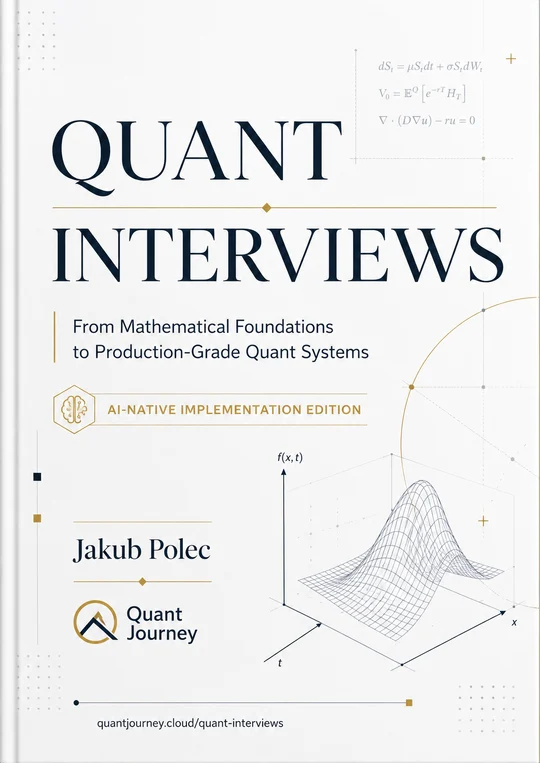
From Mathematical Foundations to Production-Grade Quant Systems
194 interview questions with full derivations, executable Python, C++ and SQL implementations and tests. If a numerical claim can be tested, it is.
1,630 pages · 194 questions · 2,319 rendered equations · 14 chapters in 2 volumes

Each question carries the derivation, implementation contract and tests behind it—so you can inspect, challenge and discuss the result, not just read the solution.
The question as asked, with role tags and expected time.
The answer given first, before any derivation.
The complete derivation; every displayed equation is numbered.
The mechanism behind the result, in a few sentences.
Recurring mistakes, stated precisely.
Where the conversation goes after a correct answer.
Estimation issues that appear when the result meets capital.
Inputs, invariants and failure conditions, fixed before code.
Source code and tests; listings are extracted from tested implementations.
A daily strategy reports an annualized Sharpe ratio of 1.5 from three years of data. Estimate its uncertainty under IID Gaussian returns. Then explain how skewness, kurtosis and autocorrelation change the answer.
With 756 daily observations, the IID Gaussian asymptotic standard error of the annualized Sharpe is about 0.58, giving a rough 95% interval of 0.37 to 2.63. The reported 1.5 is much less precise than it looks.
| Input | annualized Sharpe, observations, periods per year, skewness, excess kurtosis |
| Invariant | SE scales as inverse square root of n; rises under adverse higher moments |
| Failure | n ≤ 1, or the moment combination implies negative variance |
Search across all 194 question titles, concepts and chapter names. Or open a chapter to browse it in full.
No question titles match that search. Try a topic or chapter name.
Choose a role, not a reading order. These tracks cut across both volumes; the same question can appear in more than one track when the work overlaps.
Inference, time series, machine learning, portfolio construction and research validation.
CH01 · 02 · 08 · 09 · 12 · 14Derivatives, volatility, rates, microstructure, execution and decisions under uncertainty.
CH01 · 05 · 06 · 07 · 10 · 13Numerical methods, C++, Python, SQL, data contracts, replay and production systems.
CH02 · 03 · 10 · 11 · 12 · 14Evidence quality, portfolio construction, tail risk, attribution, capacity and governance.
CH01 · 07 · 09 · 10 · 12 · 14These questions continue past the whiteboard into execution, C++, point-in-time data and production controls.
Queue position, adverse selection, market impact, smart order routing, TCA and production execution platforms.
C++ concurrency, memory locality, numerical contracts, bitemporal SQL, stable APIs and replay-compatible components.
PIT data, event sourcing, deterministic replay, OMS, reconciliation, observability and AI-native tool boundaries.
Get the code
Clone the complete repository. It contains 210 Python files (48,408 lines), 44 C++ files (4,334 lines) and 53 SQL files (5,717 lines), plus 67 public code-only test and validator files. The implementations, tests and rendered listings come from the same source tree.
Browse the repositoryText — CC BY-NC-ND 4.0 · code & tool contracts — MIT
Enter your email once to receive the complete PDF and all 14 individual chapter files. This is a one-time delivery, not a marketing subscription. QuantJourney research & updates remain a separate, optional choice.
Full PDF. Both volumes and all fourteen chapters.
Get the PDFTwo-volume physical edition, printed for long-form study at the desk.
Pre-order with StripePrint terms. Pre-orders are paid at purchase and shipped within two weeks after printing.
Nobody is perfect, and neither is a technical book of this scale. It may contain mathematical, code, data or editorial errors. If you find one, report it publicly so it can be checked, discussed and corrected.
Report an error on GitHub Issues ↗Practical answers about the PDFs, code, licenses and printed edition.
Enter your email once and we will send a link to the complete digital edition. From that page you can download the whole book or any of the fourteen chapter PDFs separately. This is a one-time delivery email, not a marketing subscription.
Yes. The digital edition contains both volumes and all fourteen chapters. It is not a shortened preview. The printed set contains the same core book for readers who prefer a physical reference and want to support the project.
No. Your email is used to deliver access to the PDFs. QuantJourney research & updates are a separate, optional choice on the form. Leaving that checkbox empty does not add you to an updates list.
The book text is available under CC BY-NC-ND 4.0. You may share unmodified copies for non-commercial purposes with attribution. You may also cite the book in research, teaching and technical work. The code has a separate MIT license.
Yes. The Python, C++ and SQL implementations, JSON tool contracts and validation tools are MIT-licensed, including for commercial use. The license permits use; it does not replace your own review, security, model-risk or production-approval process.
A question does not stop at a short interview answer. It includes the derivation, assumptions, failure modes, an implementation contract, executable code and tests where the claim can be checked numerically. The public repository lets you inspect and run that evidence yourself.
Treat it as reviewed educational reference code, not as a drop-in trading system. The implementations and tests make assumptions visible, but every firm must validate data, numerical behavior, controls, performance, security and operational risk in its own environment.
AI is part of the research, drafting and engineering toolchain. That is one reason the book is built around executable evidence rather than a request for trust. Numerical claims are tied to code and tests, and public review can still find mistakes. Inspect the sources, run the suite and report anything that does not hold up.
Please open a GitHub issue with the chapter, question identifier and enough detail to reproduce the problem. Mathematical, code, data, citation and editorial corrections are all useful during the public review. The issue trail keeps the discussion visible and checkable.
Two durable volumes make the book practical to use at the desk. Volume I covers mathematics and markets (chapters 1–7); Volume II covers research and systems (chapters 8–14). Together they form one book, but each volume can be used independently.
Pre-orders are paid at purchase through Stripe. After payment, you confirm delivery details on a secure QuantJourney page. The two-volume set is shipped within two weeks after printing; delivery timing after dispatch depends on the destination and carrier.